Author Interviews

How to Invite and Prepare for an Author Interview at Your Book Club
An author visiting your book club is one of those evenings that can go two ways. It can be generous, surprising, and the thing members talk about for months — or it can be ninety minutes of "So, where do you get your ideas?" A little groundwork beforehand makes the difference, and most of it happens weeks in advance.
What follows is the practical version: how to ask, what to agree, and how to get the room and the readers ready.
Decide what you are actually asking for
Before you contact anyone, settle the shape of the event. An author visiting a book club could be doing any of these:
- a relaxed conversation with a moderator, followed by members' questions;
- a short reading, then open discussion;
- a workshop-style session on a craft element, such as structure or dialogue;
- a shorter video call for a club that cannot meet the author in person.
Groups of eight and groups of thirty want different things. A small club tends to do better with a conversation; a larger one often needs a bit of structure to stop the quiet members disappearing and the loud ones taking over. If you are not sure, ask the author what they are used to. Most have a preferred format, and it is usually the one they are best at.
How to approach an author
Email is fine. Keep it short, specific and easy to answer. The first message should tell them:
- who you are — the club's name, roughly where you meet, and how many members usually turn up;
- which book you have read, and why you are asking them in particular;
- two or three possible dates, with times, and how long you would like them for;
- whether it is in person or online, and if online, which platform;
- whether the club pays a fee, covers travel, or can offer something else instead — a bookshop event, a meal, a chance to sell signed copies;
- anything they should know: is it recorded, is there a photographer, is the room upstairs with no lift.
Give them room to say no. Authors get a lot of requests, and a polite "we quite understand if it is not for you" makes the message easier to answer than one that assumes agreement. If you have not heard back in a fortnight, one gentle follow-up is reasonable. After that, let it go.
Do not send twenty questions in the first email. Offer one or two, as a taste of what the club is interested in, and keep the full list for the event itself.
Agree the format in writing
Once a date is agreed, send a short confirmation that repeats everything back. Include:
- arrival time and start time, which are not the same thing;
- the format, and who is running it;
- how long the author speaks and how long members get for questions;
- whether they would like to read from the book first;
- whether there is a break, and whether refreshments are provided;
- the name and phone number of one contact person, not three.
Ask whether there is anything they would rather not be asked. Authors will usually name it plainly — a book they are not discussing, a subject that is personal, a question about the ending they get in every interview. Knowing in advance means your moderator can steer around it without an awkward moment.
If a local bookshop is involved, all the better. Shops often order copies for a group and sometimes host the event themselves. Ask early, because their calendars fill.
Set up the room
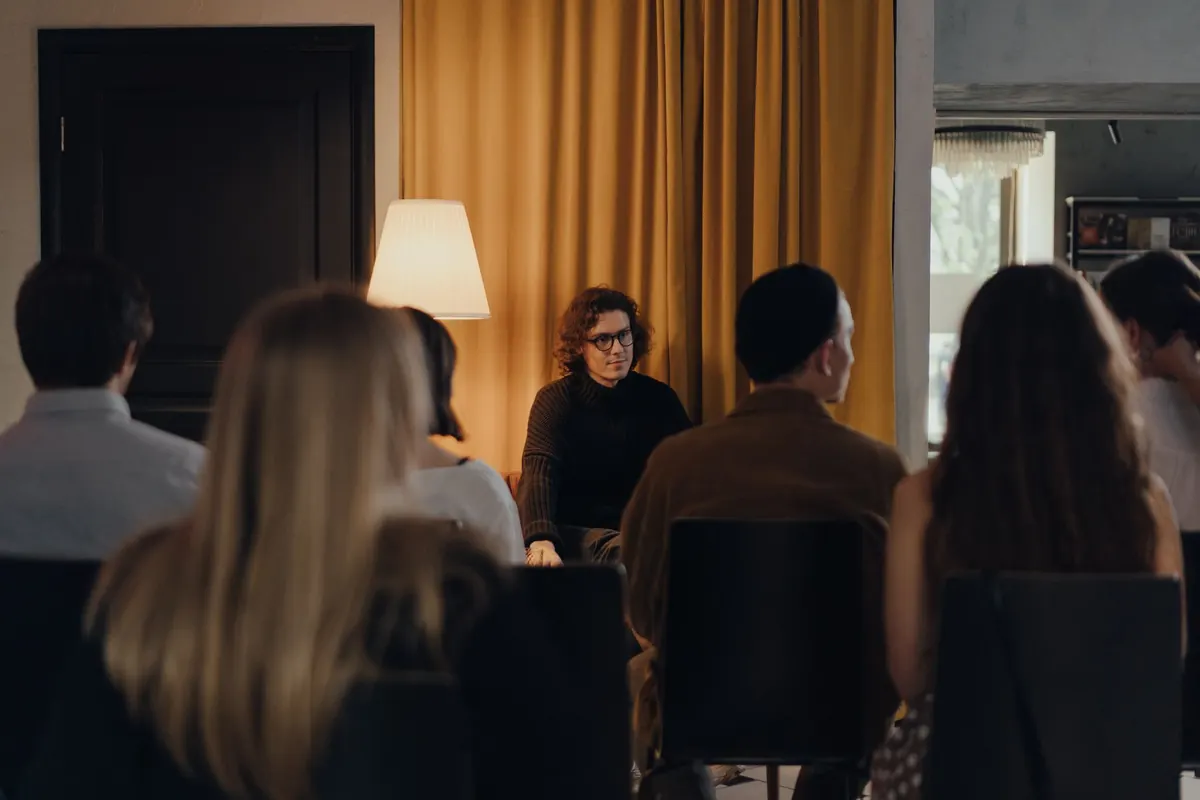
For a meeting in person, aim for a circle rather than rows. Put the author in a chair within the circle, not behind a table — the table turns the evening into a talk. Check the obvious things: heating, lighting, whether you can hear someone at the far side of the room, and whether the person next to the radiator will be too warm. Have water within reach, and somewhere quiet for the author to sit for five minutes before you begin. Name badges are useful for the author, who is meeting everyone for the first time. Do not ask them to wear one.
For a video call, appoint a host who is not the moderator. They can admit people from the waiting room, mute microphones, watch the chat and deal with connection trouble. Ask members to say their name before speaking, because voices alone are hard to place. Test the link an hour beforehand, and agree a phone number as a fallback. Keep the group small enough that everyone can speak at least once.
Prepare the members
Members who have finished the book and thought about it will carry the conversation. A short email a week ahead helps:
- Confirm the time, the format and how long it will last.
- Ask everyone to bring one question and one passage they want to talk about.
- Share three or four sample questions so nobody feels put on the spot.
Push for questions that open things up rather than close them down. "Did you enjoy writing it?" invites a yes. "Which scene was hardest to get right, and why?" invites a story. It helps to have questions in tiers: craft first, then character and choice, then the wider themes the book touches. Ask members to point to pages rather than paraphrase, so the author can tell the group has read closely.
The moderator should have a dozen spare questions written down and waiting, for the moment the room goes quiet.
On the night
Begin with a two-sentence introduction — who the author is, which book you have read — and no more. Open with a warm question about the book itself, not the state of publishing. Give a full answer time to arrive; count to five before stepping in to fill a silence, because the best remarks often come after a pause.
Keep an eye on the clock and leave fifteen to twenty minutes for member questions. Remind people gently that this is a conversation, not an opportunity to deliver a review of their own. If someone starts a speech, the moderator can thank them and hand over to the next person. Close by thanking the author properly, and offer them the last word: a current project, a recommendation, anything they would like to mention.
Your final week checklist
Seven days out, run through this and you will have very little left to worry about:
- Confirm the date, time and format with the author in one short message.
- Send members the reminder, the sample questions and the address or link.
- Check the room booking, the keys and the parking, or test the video link.
- Agree who introduces, who moderates and who watches the door.
- Print the reserve questions, and give the moderator a watch or a phone clock.
- Buy the water. Ask about the milk.
Then let the evening be what it is. A good author interview does not need to be polished; it needs to be prepared enough that nobody is anxious, and relaxed enough that the conversation can go somewhere the group did not plan.
Photo: Spudaitis / Pixabay
Related Articles